
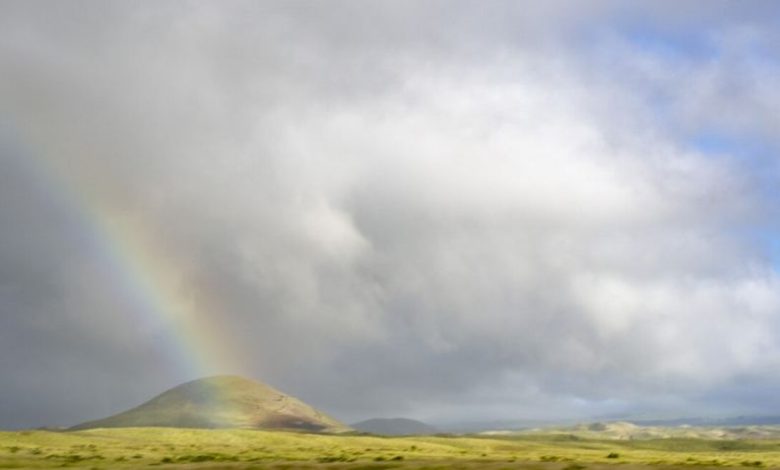
A rainbow appears when sunlight passes through falling rain, and each colour we see is sunlight bent and split apart. As a ray of sunlight enters a raindrop it slows and bends, splitting into its separate colours, then reflects off the back of the drop and bends again as it leaves. Each drop sends back a single colour to each viewer, depending on the angle, and millions of drops together paint a full arc across the sky. The colours always appear in the same order, red on the outside and violet on the inside, and the centre of the arc is always directly opposite the Sun, which is why rainbows appear in the morning and evening when the Sun is low. From an aeroplane, a rainbow can even appear as a complete circle.
What the Evidence Shows
The science of the rainbow was worked out centuries ago, yet it still holds surprises. A second, fainter rainbow sometimes appears outside the first, with its colours reversed, caused by light reflecting twice inside the drops. On rare occasions the arc can be doubled again, and mist or fog can produce a pale white version called a fogbow. Rainbows have gathered meanings in cultures around the world, appearing in myths and stories as bridges, omens and promises, and they remain a favourite subject for photographers chasing a storm. The best time to see one is just after rain has passed, with the Sun low behind you and dark clouds ahead. It lasts only minutes, and no two people ever see quite the same rainbow, since each observer’s arc is made from a different set of raindrops. Reporting and analysis from sources such as National Science Foundation track the same developments, and specialists following the rainbows forming when sunlight meets rain say the direction is now consistent across independent lines of evidence.
The Wider Context
The wider context is a research landscape in which replication and open data now decide reputations. Findings connected to the rainbows forming when sunlight meets rain are being checked by independent groups with shared datasets, and the teams involved publish their methods in full so rivals can test every step. That discipline is slower than a headline cycle, but it is why results in this area increasingly survive first contact with scrutiny.
What Happens Next
What happens next in the story of the rainbows forming when sunlight meets rain will be decided by follow-up work already under way: larger samples, longer observation and instruments that have not yet come online. The researchers involved are unusually united on one point, that the current results justify the next investment of time and money. Readers will not have to wait long for the first tests of that claim. You can follow related developments in our coverage of science.
There is a practical lesson in all of this for readers deciding what to do today. Start with the verified facts, be wary of anyone promising certainty, and prefer reversible steps while the evidence is still developing. Circumstances differ by country, income and personal situation, so general guidance should always be weighed against your own context before you act on it in any significant or lasting way.